 Daodao
 connects voting power and proposal modules to govern shared treasuries
Last updated -Daodao combines smart contracts and a web interface so groups can form a decentralized autonomous organization (DAO) and govern a shared treasury. Its design separates voting power, proposal handling, and treasury custody into distinct modules. Participation can rely on staked governance tokens, staked non-fungible tokens (NFTs), or a defined membership list. Proposal modules determine how the group considers decisions. The core module holds treasury assets and carries out authorized actions. This separation lets a group choose its participation model independently of its proposal format. The interface supports DAO creation, proposal voting, and treasury management without requiring users to write code. Governance can also change membership, update settings, and manage connected accounts.
Key takeaway: A DAO's participation model and proposal format are separate choices, linked through standard module interfaces and the core that holds treasury assets.
Voting power and proposal modules meet at the core
Three module categories divide the governance system: one voting power module, any number of proposal modules, and one core module. Proposal modules obtain voting power through the shared contract architecture, while the core manages the attached modules. Standard interfaces allow a voting power module to work with different proposal modules. This arrangement lets distinct ballot formats use the same participation model. Replacing a ballot format and changing who has voting power address separate parts of governance.
Voting power follows the chosen participation model
A member-based DAO assigns voting weight to a defined set of addresses, with membership changes governed through proposals. Existing members vote on adding members, removing them, or adjusting their weights. The weights can differ, so an address count alone does not describe the distribution of influence. This model supports collective asset management without requiring a governance token.
In the staked-token model, voting power comes from governance tokens that members have staked. Merely holding those tokens in a wallet does not register them for voting. Staked tokens cannot be transferred while they remain staked. An unstaking duration, when configured, adds a waiting period before the tokens can be claimed.
In the staked-NFT model, members obtain voting power by staking NFTs. Non-fungible assets provide a different participation basis from fungible governance tokens. The selected voting module determines how that input contributes to voting power. Choosing NFTs therefore concerns the source of influence, while the proposal module still governs the ballot.
In the documented member-based and token-based models, proposals use a snapshot of voting power when they are created. Joining afterward affects future proposals. A membership change during an existing vote does not rewrite that proposal's electorate. A member's current voting power can therefore differ from the power counted for an older proposal.
A treasury asset does not automatically become a governance asset; the voting module identifies what contributes to voting power.
Proposal modules define ballots and executable actions
Single-choice proposals present Yes, No, and Abstain options, with an optional set of actions attached to the motion. Multiple-choice proposals present alternatives that can each carry their own actions, alongside a None of the above option. An action is a blockchain instruction, such as spending treasury assets or changing membership. Proposal text explains the motion, while the attached instructions determine its executable effects. Multiple-choice support requires a DAO on V2 or later with the relevant proposal module enabled.
The initial Condorcet ranked-choice module lacks human-readable proposal names and descriptions. It also lacks revoting, pre-propose integration, and proposal and vote hooks. Its first implementation is not ready for a human-facing frontend.
The core holds assets and implements authorized decisions
The treasury belongs to the core contract, which holds assets and manages the DAO's voting and proposal modules. The core executes messages that authorized proposal modules send to it. Passing a proposal establishes approval, while execution carries out its attached instructions. A motion can also contain no actions and simply record a collective decision. A treasury transfer requires executable instructions that identify the intended payment, and approval alone does not establish that the transfer occurred.
Proposals, votes, and outcomes form public blockchain records. A motion's description is part of this public governance process. Personal information included in that text can become visible alongside the voting record. Treasury actions can change asset balances, while other actions can update membership or contract configuration.
A SubDAO adds another authority relationship: it is a DAO with another DAO set as its administrator. The parent can execute actions on the child's behalf, including treasury spending and membership management. This hierarchy supports separate organizational groups while retaining parent administrative power. The child's voting arrangement therefore operates alongside the authority that its parent holds.
In core version 2.6.0, a pause blocks execution calls except those from the administrator or core itself. The administrator can end it before the configured expiry.
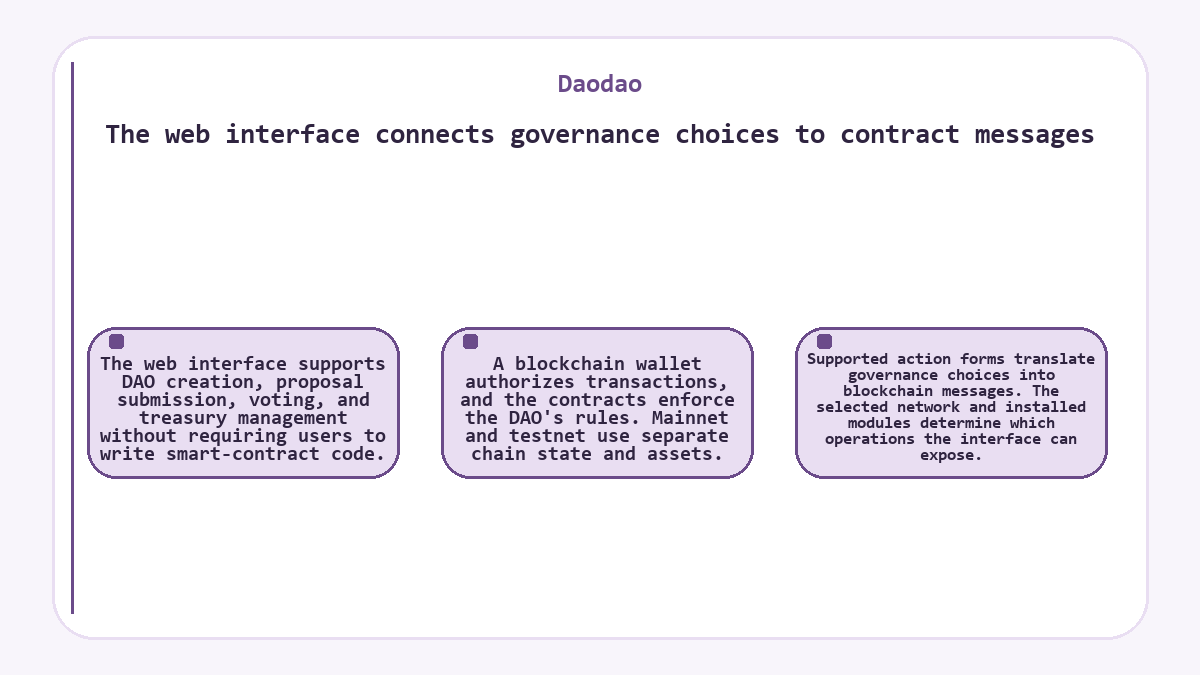
The web interface connects governance choices to contract messages
The web interface supports DAO creation, proposal submission, voting, and treasury management without requiring users to write smart-contract code. A blockchain wallet authorizes transactions, and the contracts enforce the DAO's rules. Mainnet and testnet use separate chain state and assets. Supported action forms translate governance choices into blockchain messages. The selected network and installed modules determine which operations the interface can expose.
Configured parameters determine participation and timing
Voting duration sets a maximum period for a proposal, while revoting changes whether an outcome can settle before that period ends. With revoting enabled, proposals remain open for their full duration because voters can change their votes. Disabling it can permit early passage or failure once the votes determine an outcome. Single-choice and multiple-choice configurations can be changed separately through governance, so a shared treasury does not require identical voting settings.
| Parameter | Available setting | Timing or scope |
|---|---|---|
| Voting duration | DAO-configured maximum voting period | Bounds the proposal's voting window |
| Revoting | Enabled or disabled | Enabled keeps voting open for the full duration |
| Unstaking duration | DAO-configured waiting period, where enabled | Delays availability of unstaked governance tokens |
| Proposal submission | Members only or anyone | Controls eligibility to submit new proposals |
Quorum measures the proportion of total voting power that must participate for a proposal to be passable. A single-choice passing threshold separately governs the support needed for approval. Multiple-choice proposals use quorum and plurality voting, with their own configuration. These settings express different requirements: participation and support. Under different settings, the same distribution of votes can produce a different decision. The configured voting period also remains distinct from an unstaking period, which governs access to tokens.
Cross-chain control depends on connections and compatible runtimes
Cross-chain accounts extend DAO control beyond its home chain through Inter-Blockchain Communication (IBC). Polytone uses CosmWasm contracts to establish these accounts. Polytone requires CosmWasm and IBC support on both connected chains. Each connection works in one direction, from a source chain to a destination chain. Connections in opposite directions provide reciprocal support. The required contracts must be deployed before that relationship exists; a chain's general technology support alone does not create a usable connection.
Interchain Accounts (ICA) uses a native Cosmos SDK module and can support destinations without CosmWasm when the necessary account infrastructure exists. Host-chain rules can restrict the messages an ICA executes. A Polytone account also depends on its IBC connection: expired clients can freeze the connection and temporarily prevent access through it. These mechanisms have different deployment and operating conditions, so a cross-chain account does not imply unrestricted control across every chain.
Contract compatibility depends on the selected functionality and runtime. Float-bearing RBAM/filter functionality requires CosmWasm/wasmvm 1.5 or later. That requirement applies to those features, without establishing a universal minimum for every governance contract. In builds that use
serde-json-wasm
0.5.2, the serializer panics when asked to serialize an actual floating-point JSON value through
serde_json::Value
. Floating-point runtime support does not change that serializer's capabilities.
The contract code is open source, and Oak Security has audited versions of the tooling. Audit coverage concerns particular code versions. A change of modules, contract version, or deployment environment changes the conditions that govern compatibility and execution.
Quick answers about Daodao
Does creating a proposal require a token deposit?
A proposal requires a deposit only when the DAO's proposal submission configuration enables one. The configured deposit can use a governance token or another token on the chain. Its refund policy can return deposits for all proposals, only passed proposals, or no proposals. A deposit is separate from the proposal's voting rules.
When can I transfer governance tokens after unstaking?
You can transfer unstaked governance tokens once they have returned to your wallet, provided the token's transfer rules permit it. The token-based interface distinguishes staked, unstaking, and available tokens. If a waiting period is configured, its end permits a claim transaction that returns the tokens to your wallet. With no duration configured, the native-token staking module returns them in the unstake transaction.
Why does a received contract token sometimes stay hidden in the treasury?
A received CW20 token or CW721 NFT can belong to the DAO without appearing in its treasury display. The interface tracks registered contract assets, while native-bank assets use a different discovery mechanism. Registration can be added by passing and executing a governance proposal. If registration is already complete, an indexer issue can also prevent the display from updating.
Can I include a custom message in a Daodao proposal?
The proposal interface supports custom messages for actions beyond its predefined forms. A custom message specifies the blockchain instruction that the proposal would execute. Its effect still depends on the target contract or chain module, the DAO's authority, and the proposal reaching execution. Adding a message does not expand the permissions of the DAO.
Which license applies to the governance contract code?
The governance contract repository uses the BSD-3-Clause license. Its source code is open, allowing developers to inspect the governance implementation and the interfaces that connect its modules.